






Overview
The modern job search often involves applying to multiple roles across different websites and tailoring resumes, which makes it hard for job seekers to track and manage application materials and statuses.
HireFive is a job search platform that streamlines the application process by enabling users to apply for jobs, manage application materials, optimize resumes, and track interviews in a centralized system.
Duration
January 2026 - August 2026
My Role
UX Researcher
UI/UX Designer
Product Designer
Tools
Figma
FigJam
Qualtrics
Miro

Process

1. Research
User interviews
Surveys
Persona
User Journey Map
Comparative Analysis
2. Design
User Flow Diagram
Low-Fidelity Wireframes
High-Fidelity Prototype
3. Refine
Usability Testing
Design Iterations
4. Final
Impact
Next Steps

1. Research
User Interviews
To uncover why the modern job search feels chaotic, I conducted semi-structured user interviews evaluating how job seekers navigate fragmented workflows, application organization, and platform fatigue.
Synthesizing the qualitative data through thematic mapping, I discovered the following three systemic friction points impacting job seekers.

Tool Disconnection
Standard job boards lack native management tools, forcing users to manually fragment their data across external tools like Google Sheets.

Resume Screening Blindspot
Job seekers apply blindly without knowing if their resume format or keywords will pass automated Applicant Tracking Systems (ATS).

Untracked Timelines
Standard job boards lack integrated tracking tools and automated interview reminders, leaving users prone to missing critical dates.
Surveys
To analyze behavioral patterns across a broader population of the target audience, I distributed quantitative surveys via Qualtrics. While the data validated the three interview friction points, it also revealed a distinct behavioral pattern regarding file management.

Document Fragmentation
72% of participants rely on digital folders to manually store their job materials, but over 90% of them fail to track the documents they submit for each application.

Insight & Opportunity:
Most job seekers prefer using folders to manage materials, but manually switching tools makes it hard for them to keep track of their documents. Thus, HireFive should automatically create a folder for each application users submit within the platform.
Persona
Based on the research data, I created a primary persona to ensure that every design decision directly reflects user needs.





Frustrations
Overwhelmed by disorganized job documents.
Uncertain about how ATS screeners work.
Prone to losing track of interview timelines.
Goal
Streamline her workflow into a single platform integrating document management, resume enhancement, and timeline tracking.
User Journey Map
Using the persona, I outlined four key phases of the user experience. From there, I developed a journey map to visualize the user's behaviors across these phases and identify critical design opportunities.
Comparative Analysis
To assess how the market currently handles application workflows and make the application more competitive, I conducted a comparative audit to evaluate the strengths and weaknesses of the platforms that share similar features: Indeed, Teal, and Jobscan.




2. Design
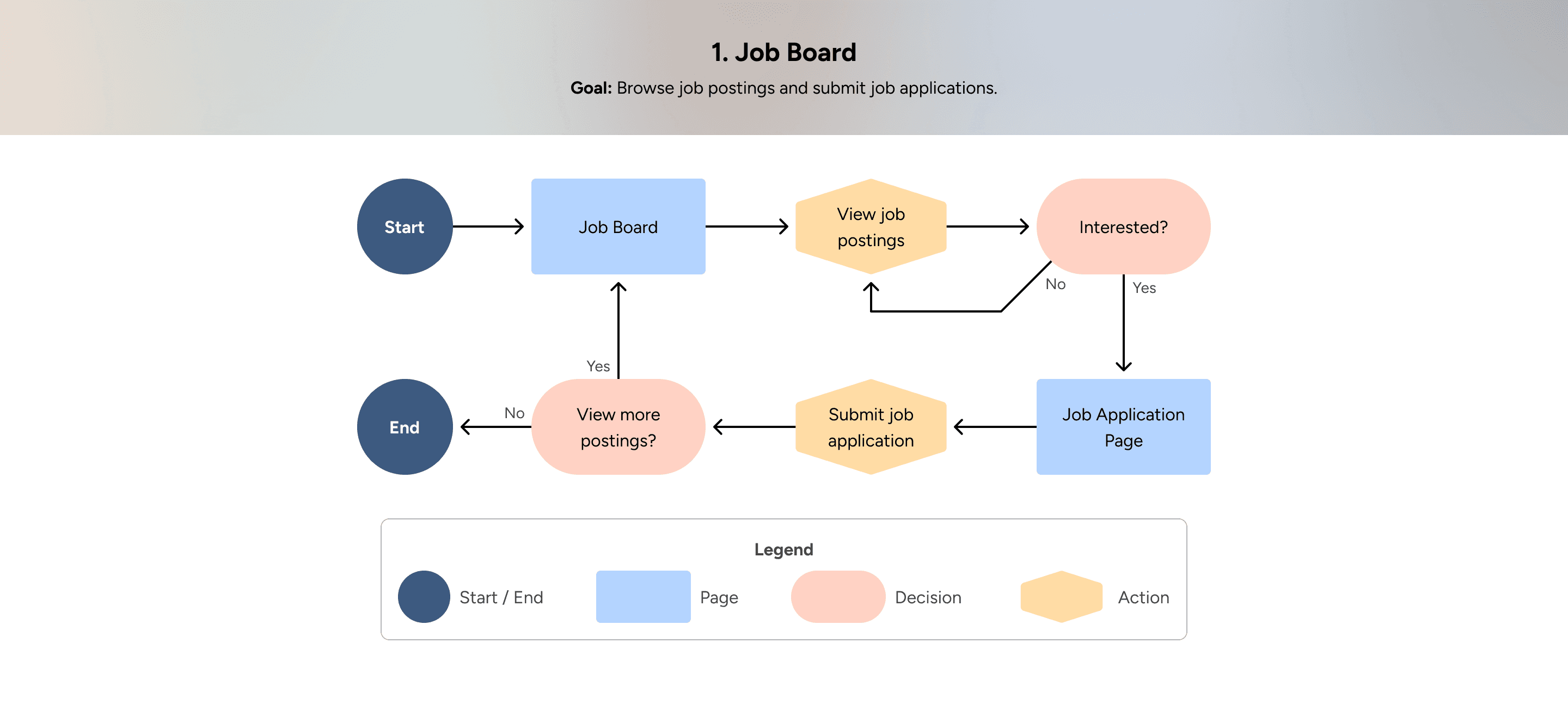
User Flow Diagrams
Synthesizing my research, I translated user needs into four key modules: a Job Board, Job Tracker, Resume Checker, and Calendar. I then mapped out a user flow diagram for each to establish an intuitive ecosystem architecture.


Low-Fidelity Wireframes
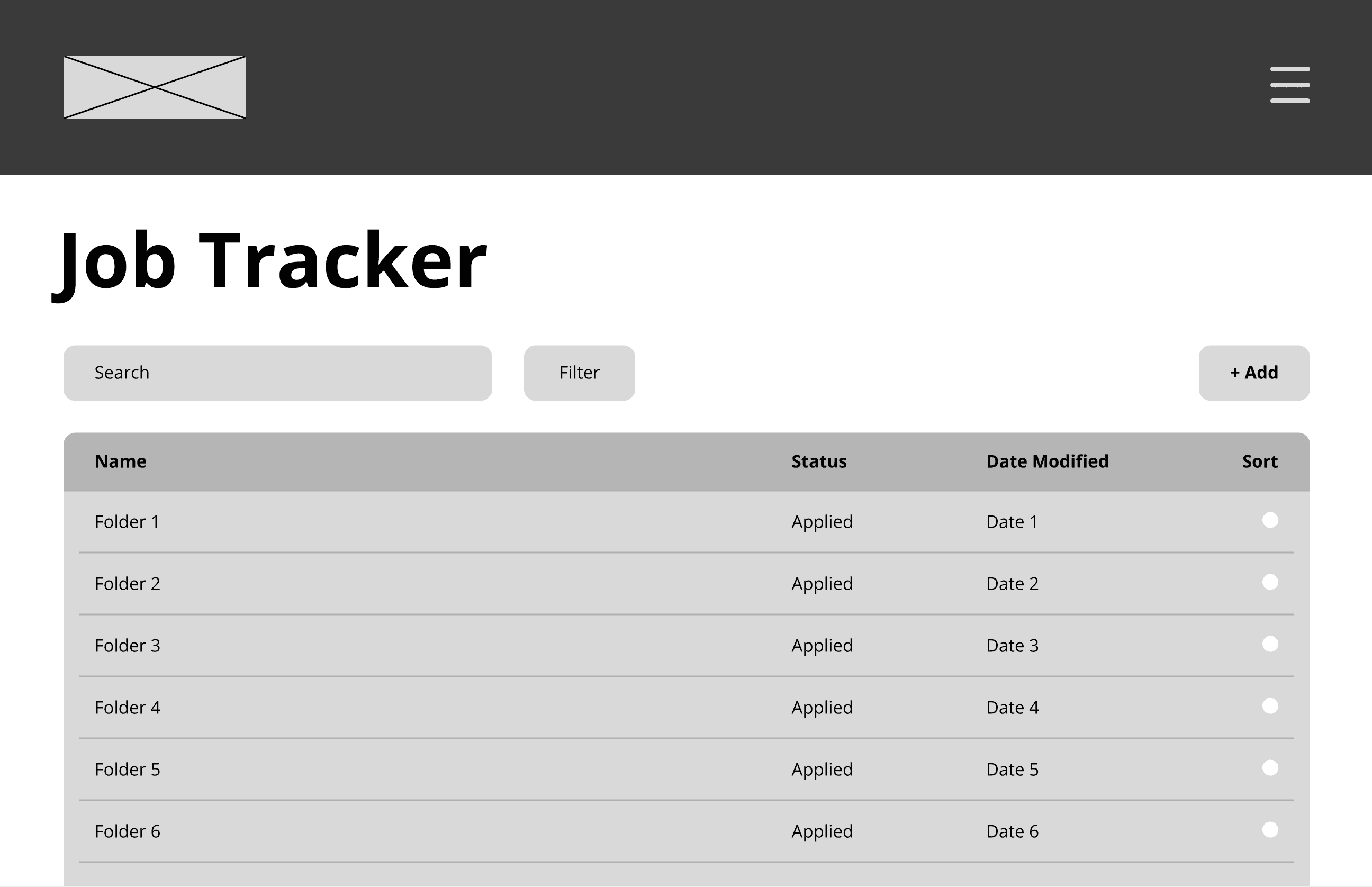
Using Figma, I translated user flows into low-fidelity wireframes, focusing strictly on information architecture, visual hierarchy, and spatial layout without the distraction of aesthetic styling.
Because users primarily access HireFive on desktop during focused work sessions, maximizing data clarity was critical. I implemented a split-screen layout for the Job Board, structured folders for the Job Tracker and Resume Evaluation Report, and a grid-based system for the Calendar to ensure instantaneous asset retrieval.



High-Fidelity Prototype
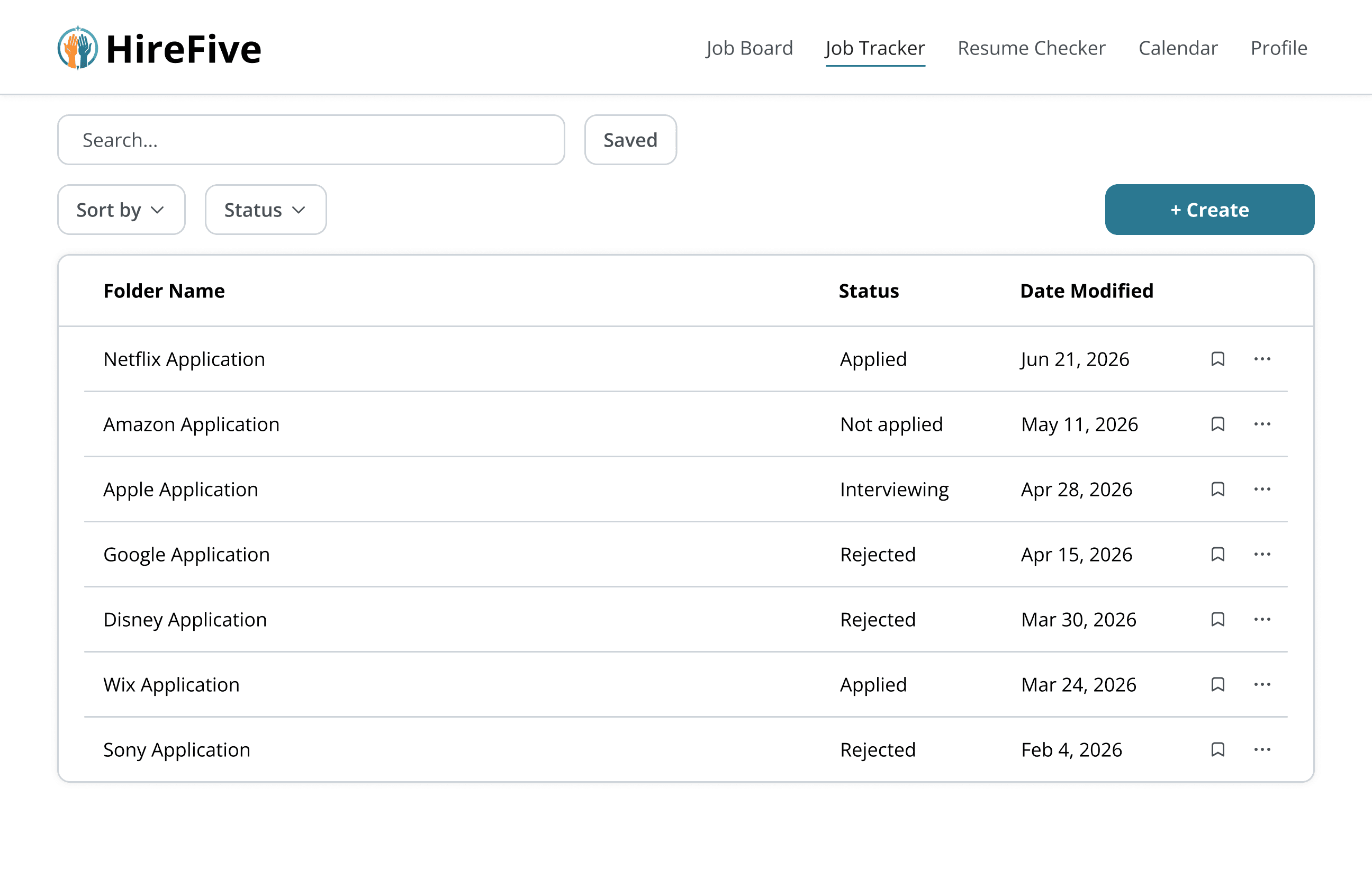
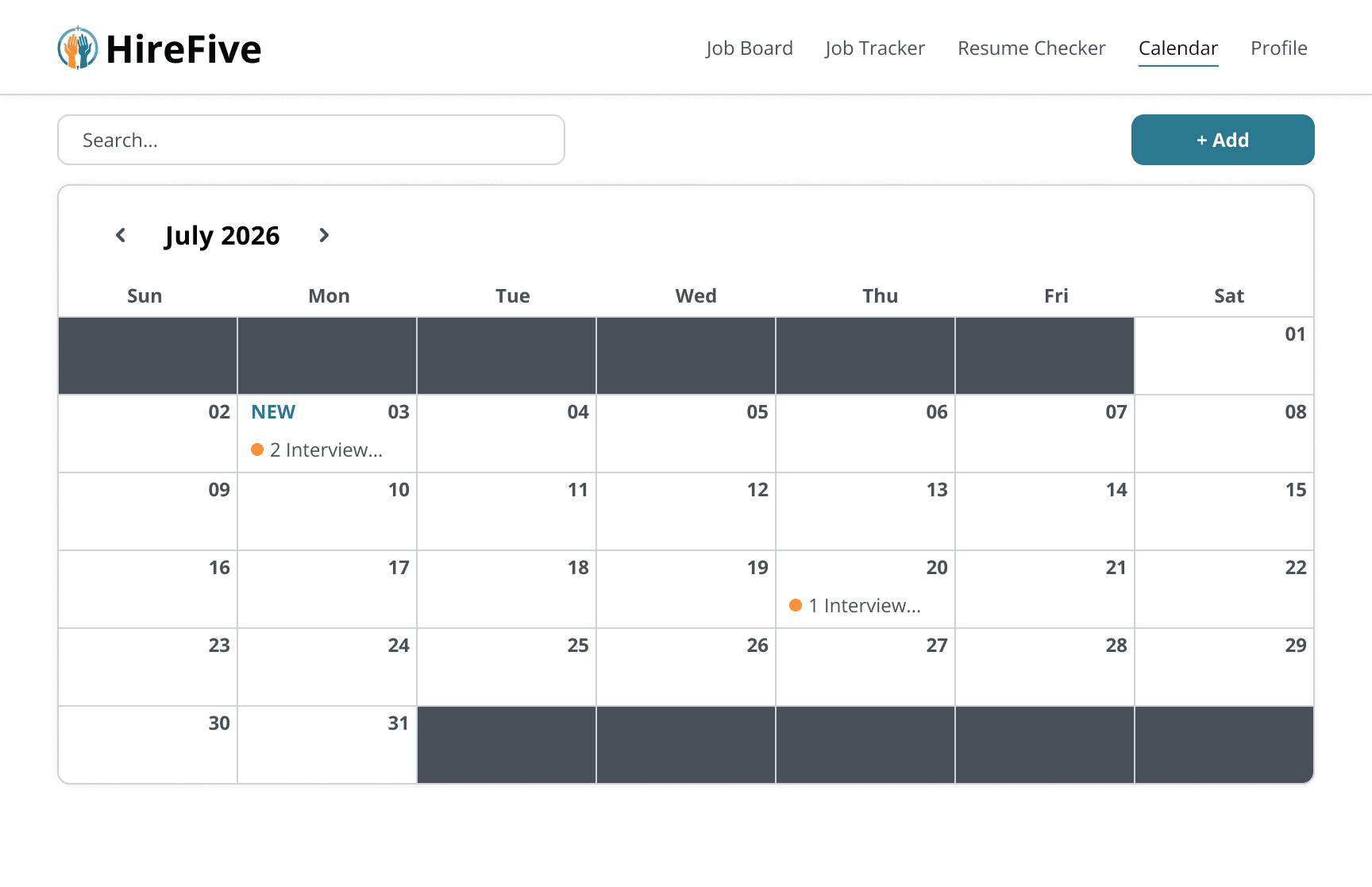
I turned the wireframes into a high-fidelity prototype that simulates the comprehensive HireFive ecosystem.
To minimize manual user maintenance, I designed cross-system logic where actions in one module automatically update another. For example, updating an application status to "Interview" inside the Job Tracker instantly synchronizes and schedules the event details within the Calendar.


3. Refine
Usability Testing
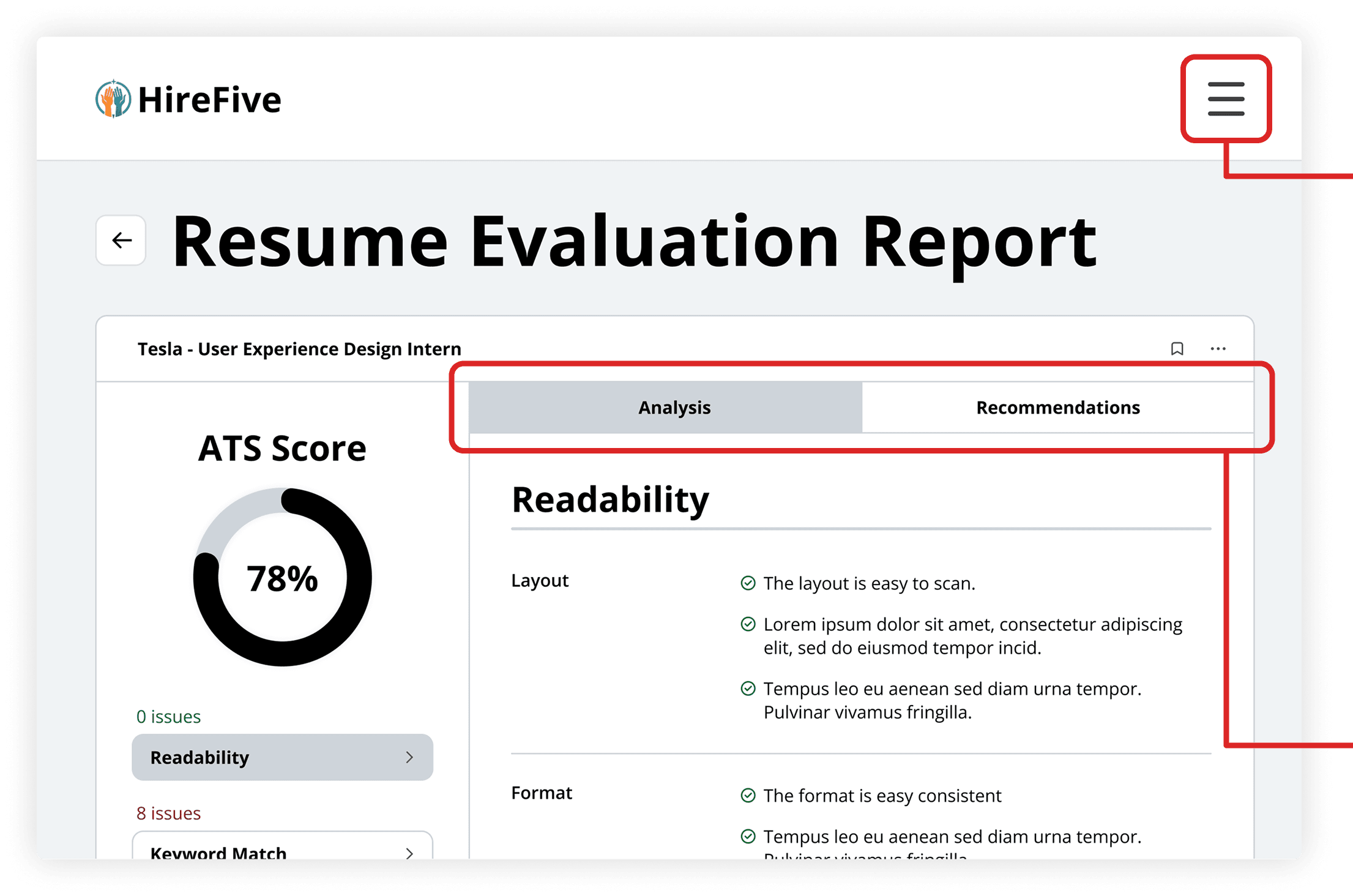
To validate the platform's navigation and unified ecosystem, I conducted three rounds of moderated usability testing and discovered two critical issues:
Navigation Friction: Participants spent extra time navigating because primary desktop menu items were completely hidden inside a mobile-style hamburger menu.
Low Visual Affordance: Participants failed to recognize that the "Analysis" and "Recommendations" sections were interactive tab options due to their flat styling.


Design Iterations
Integrating both quantitative behavioral metrics and qualitative feedback from usability testing, I executed strategic layout revisions to refine the final desktop scope.
To resolve the core friction points identified by users, I implemented two major iterations:
Persistent Global Navigation: Primary menu links were pulled out of the hamburger menu and placed into a top navigation bar, eliminating secondary clicks and accelerating page-to-page transitions.
Real-world Conventions: The report section was redesigned using block-style tab indicators to mimic a physical binder and give users an immediate visual cue that the components are interactive.


4. Final
Impact
The final round of usability testing involved five participants, yielding the following three key metrics that validated the overall success and product value of HireFive.

100% Task Completion Rate
All participants seamlessly navigated the unified platform ecosystem and executed critical workflows within 20 minutes.

94% Rating
Participants awarded a 94% average usability score, confirming that the platform successfully streamlines and optimizes their job search processes.

High Feature Clarity
A total of 80% of participants intuitively understood and correctly interacted with complex platform features without hesitation, proving the effectiveness of the high-affordance UI updates.
Next Steps
To continue scaling HireFive and maximizing its market value, the following strategic next steps will guide the platform's product roadmap.

Continuous Iteration
Conduct further usability testing rounds to identify and address potential issues.

Employer Dashboard
Design an Employer Dashboard to let employers post jobs and interact with job seekers directly on the platform.

Feature Expansion
Scale the Resume Checker to allow users to edit their resumes within the platform.

